AI can now build software in hours. Your specification is the bottleneck.
A vague requirement used to cost days of rework. Now an AI builder implements the wrong thing in an afternoon — silently. ReqQA systematically analyses your requirements and user stories for defects, gaps and ambiguities before a line of code is written, then manages the handover to human or AI builders.
Is coding a solved problem? The bottleneck just moved. Here's where.
{{ latestPaperTitle }}
Inline reading isn't supported on small screens. Open the paper in its own tab instead.
Open the paper ↗AI-assisted development makes weak specifications more expensive, not less.
Requirements are written quickly, reviewed informally if at all, and handed over with an optimistic "that should be clear enough." It usually isn't — and the faster code gets built, the faster that costs you.
AI resolves ambiguity silently
A human developer asks a clarifying question. An AI builder makes a plausible guess — which may be completely wrong — and ships it with confidence.
Review doesn't scale
Sustaining systematic coverage — edge cases, error conditions, non-functional concerns — across hundreds of requirements is beyond informal human review under time pressure.
"Good enough" no longer is
When development takes hours instead of weeks, the bar for specification quality must rise at the same rate as development speed. Most teams' processes haven't.
A continuous quality loop — from mission statement to accepted build.
ReqQA is analytical first, generative second. It doesn't just draft content — it applies a repeatable, multi-dimensional analytical framework to every specification, proposes concrete reviewable fixes, and measures whether quality is converging.
Enter the lifecycle at any point — start from a mission statement or import existing requirements and analyse immediately. The handover loop is optional.
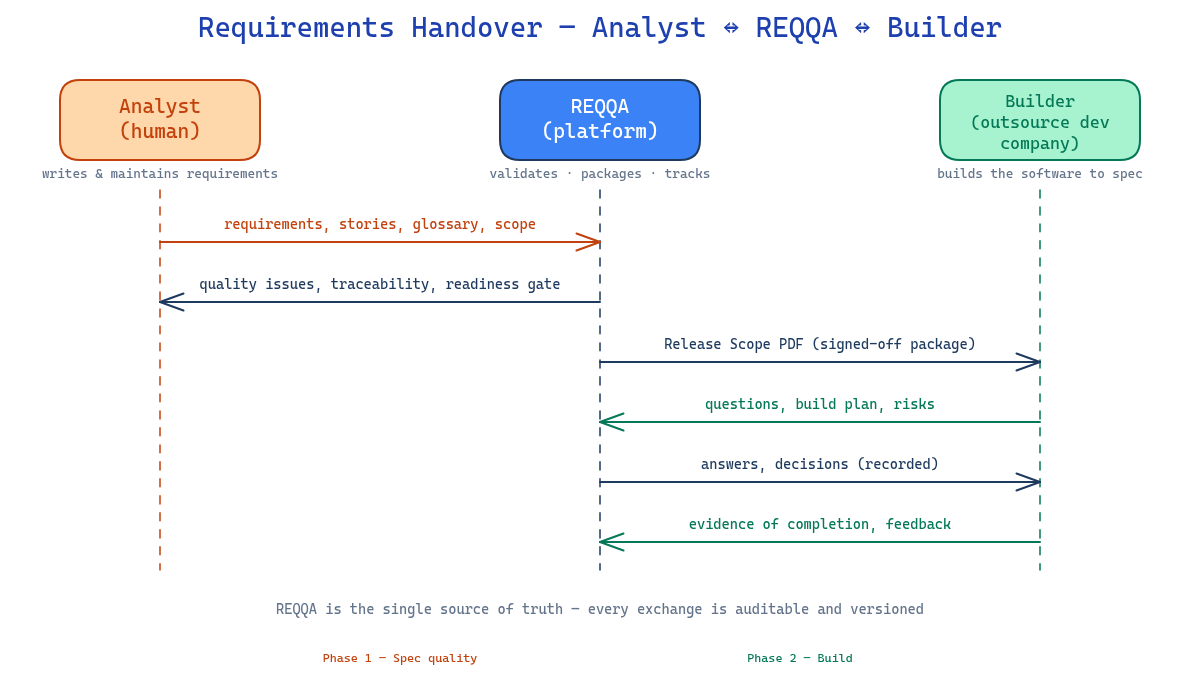
ReqQA sits between the people who own the requirements and whoever builds — an outsourced team, an in-house team, or an AI agent. Every exchange is auditable and versioned.
Analyse
Eleven complementary dimensions per requirement — definitions, goals, interfaces, rules, entities, conditions, boundaries, quality attributes, ambiguity, missing elements. Seven-step DeFOSPAM analysis for every Gherkin user story. Every finding becomes a structured, tracked issue with severity and recommendation.
Improve
Synthesis turns accumulated issues into concrete change proposals — word-level diffs you accept or reject per group. Convergence tracking shows whether each specification is actually getting better across cycles, or stalling.
Hand over
Scope a release, snapshot it immutably, and let a builder negotiate a versioned build plan through a public API. Mid-build feedback flows back into issue management; as-built records close the loop at acceptance. The builder can be an AI agent — but the discipline pays off just as much for an offshore supplier, a contractor, or your own team.
From an analysed mission to reviewable requirements in minutes, not weeks.
Once your mission statement has been through the analyse–improve loop, ReqQA can generate a full first-cut requirements set from it — and Gherkin user stories from the identified features, with syntax validation, glossary terms and traceability built in. The dependency is deliberate: generation is only as good as the mission it grows from. Get the mission right and weeks of drafting effort — and elapsed time — collapse into a review exercise.
And because each Gherkin story examples a feature in use, stories convert directly into automated test cases — better requirements make automated test generation dramatically more reliable.
From obligation to evidence: assurance you can show to a board, an auditor or a regulator.
When software is increasingly written by AI, the requirement becomes the specification of record. For regulated organisations that raises three questions at once: what exactly do we need and what are we obliged to have, does what we are buying or building meet it, and can we show it? ReqQA is where the definition lives. It analyses it, traces it through stories and scenarios to verification, hands it to builders and suppliers, and keeps the evidence.
ReqQA complements compliance management systems; it does not replace them. They answer whether your controls are operating. ReqQA answers whether what was asked for, and what was delivered, satisfies what you are obliged to do.
ReqQA can template your mission and requirements from the standards and regulatory frameworks you must work to. The AI benefits enormously from the clarity, organisation and depth those documents demand — and so does everyone downstream. Our ReqQA Standard template set ships today: it asks for the information a rigorous specification needs — the same information published guidance such as ISO/IEC/IEEE 29148 identifies, and which we check ourselves against rather than claim to implement. If you must work to a particular standard, we build a template for it within days — it's just data.
Structure that holds up to an audit
Where requirements must answer to industry standards or regulation, ReqQA builds the structure of your mission and requirements from those source documents — so the discipline is applied from the first draft rather than reconstructed afterwards. The judgement of whether you comply stays where it belongs: with you and your auditor.
Formal templates without the formality tax
Generate against a formal template — the ReqQA Standard set, or one built for your own house style — and the AI produces the "extra" content a rigorous specification requires, with no extra human input. Teams without a strong track record of writing excellent requirements get the discipline for free.
Standardised structure, predictable content
Templated specifications mean every requirement arrives in a consistent shape, with consistent depth. Better for reviewers, better for estimators — and markedly better for the build agent, human or AI.
The audit trail comes free
Every requirement, story and change is version-tracked, and every change is approved by a human. That's the traceability and accountability record most regulatory frameworks demand — produced as a by-product of working, not as a separate compliance exercise.
Available now
Requirements, stories and scenarios analysed for quality; traceability from requirement to story to verification; a per-application test strategy that decides what “covered” means before any test is written; a full audit trail of every change; a log of every AI call; and a handover to builders through a public API. Obligations can be written as requirements today.
In development
An obligations register that records the source, clause and applicability of each obligation; an assurance framework and evidence management; baselining and approval; and gap assessment of existing systems against the definition, so a portfolio can be kept, replaced or rewritten on evidence. Business-process specification and on-premise deployment are being shaped with prospective clients.
ReqQA specifies, checks, traces and evidences. It does not build the software, and it does not give legal or regulatory advice: it shows whether the obligations you have defined are covered, and the evidence that they are.
Example guard rails: healthcare, med-tech and medical-device frameworks — where we work with a specialist partner in Ireland — and the mandated requirements templates common across financial services and fintech.
We run our own product through its own discipline — daily.
Since February 2026 the ReqQA codebase has been written and managed entirely by Claude Code, working as a pair partner — humans make the key decisions and approve every change. Since March, every enhancement to ReqQA is captured in ReqQA itself: ideated in conversation with Claude, drafted as requirements, posted to the platform, then analysed, improved, scoped and handed over to build through the full lifecycle.
Every code release since May 2026 has shipped through the handover loop itself: requirements defined and approved in ReqQA, build plans submitted by Claude Code and approved by a human, all coordinated through ReqQA's public API. The releases are the validation.
Figures: ReqQA analysing its own requirements and stories, 409,054 words across 465 analyses, snapshot of 7 October 2026; 1,026 of the 4,240 fixed were high-severity. Production trials opened April 2026. Multi-tenant, deployed, shipping regularly — with a per-release SBOM (CycloneDX 1.5) supporting EU CRA and US EO 14028 due-diligence.
Three ways in.
Trial ReqQA on your specifications
For organisations building medium-to-large systems. Import your existing requirements and see what systematic analysis finds — or explore the full workflow through a catalogue of realistic training applications, clean or with seeded defects. Production trials are open.
Request a trial →Deliver ReqQA-powered engagements
We believe this market is consultancy-led. If you provide testing, QA, or requirements analysis and management services, ReqQA gives you a repeatable, evidence-producing methodology to build engagements around. We're actively seeking early partners to shape the offering with us.
Partner enquiry →Back the first year
We're raising a pre-seed round from angel investors to fund our first year of operation: product development, partner-led go-to-market, and the video and podcast programme that will define the specification-quality category. The product works today — we're funding the market around it.
Investor enquiry →Product overviews and market vision.
Short product walkthroughs, alongside longer talks on why specification quality will define the AI era of software.
The first videos are being recorded now. They'll appear here as soon as they're published.
{{ activeDescription }}
{{ paneEmptyText }}
Thirty years of asking "how would we test that requirement?"
ReqQA is built on four decades of software management and QA consulting. Its founder published papers on requirements and requirements testing thirty years ago, and fifteen years ago created the methodology for testing Gherkin stories that became DeFOSPAM — now implemented in the product and extended to cover requirements themselves.
This isn't a prompt wrapped in a UI. It's a proven analytical discipline, made repeatable and fast by AI.

From testing requirements in 1993 to building ReqQA.
Paul Gerrard is a consultant, teacher, author, webmaster, programmer, tester, conference speaker, vlogger and publisher. He has worked on every aspect of software testing and quality assurance, specialising in test assurance, and has given keynote talks and tutorials at conferences across Europe, the USA, Australia and South Africa — and occasionally won awards for them.
He first wrote about requirements in 1993 and 1994, in two EuroSTAR papers on testing them. About fifteen years ago he created the methodology for testing Gherkin stories that became DeFOSPAM. That thread, from requirements through stories, is the one ReqQA follows.
After some experimental work in 2025, he began serious development of ReqQA with Claude Code in February 2026. That was the revelation: AI could write code better than he could, so he committed never to write code again. The idea behind ReqQA follows from it. Once AI can build software in hours, the specification becomes the bottleneck, and the discipline he had spent three decades applying to requirements and stories was exactly what was missing. He formed Requirements QA Limited on 19 June 2026 to bring ReqQA to market, and he runs ReqQA's own development through ReqQA, every day.
Inaugural TESTA Lifetime Achievement Award, 2013
ISTQB Testing Excellence Award, 2018
Principal, Gerrard Consulting Limited
Host, Technology Leadership Forum
Co-director, Technology Unleashed
Programme Chair, EuroSTAR 2014, Dublin
Leading the creation of the Test Engineering Society
The Tester's Pocketbook, 2009
The Business Story Pocketbook, with Susan Windsor, 2012
Lean Python, self-published 2014; Apress edition 2016
Digital Assurance, 2017
Educated at the universities of Oxford and Imperial College London.
Press releases and announcements.
Company news and press releases.
No announcements yet. Check back soon.
See what ReqQA finds in your specifications.
A demo takes thirty minutes — bring a requirement you think is finished.